
The top two reasons travelers should make Vernal, Utah a destination are Dinosaur National Monument and McConkie Ranch Petroglyphs. Period.


This post is all about McConkie Ranch. I’ll tell you about Dinosaur National Monument another day.
If you don’t want to see McConkie Ranch Petroglyphs after reading this post, please don’t tell me. I’ll be so disappointed. If you’ve already been there, tell me what you thought about McConkie in the comments.
How I Found McConkie Ranch
Vernal, Utah was the last big stop on our two-week 2025 road trip. I couldn’t imagine driving all the way to Vernal to see just one thing (Dinosaur National Monument), so I zoomed in on Google Maps to see if there might be another point of interest close by. Indeed, there was- McConkie Ranch Petroglyphs.
All I had to see was the word “petroglyphs” to know we were going. My addiction is real, people.
What is McConkie Ranch?
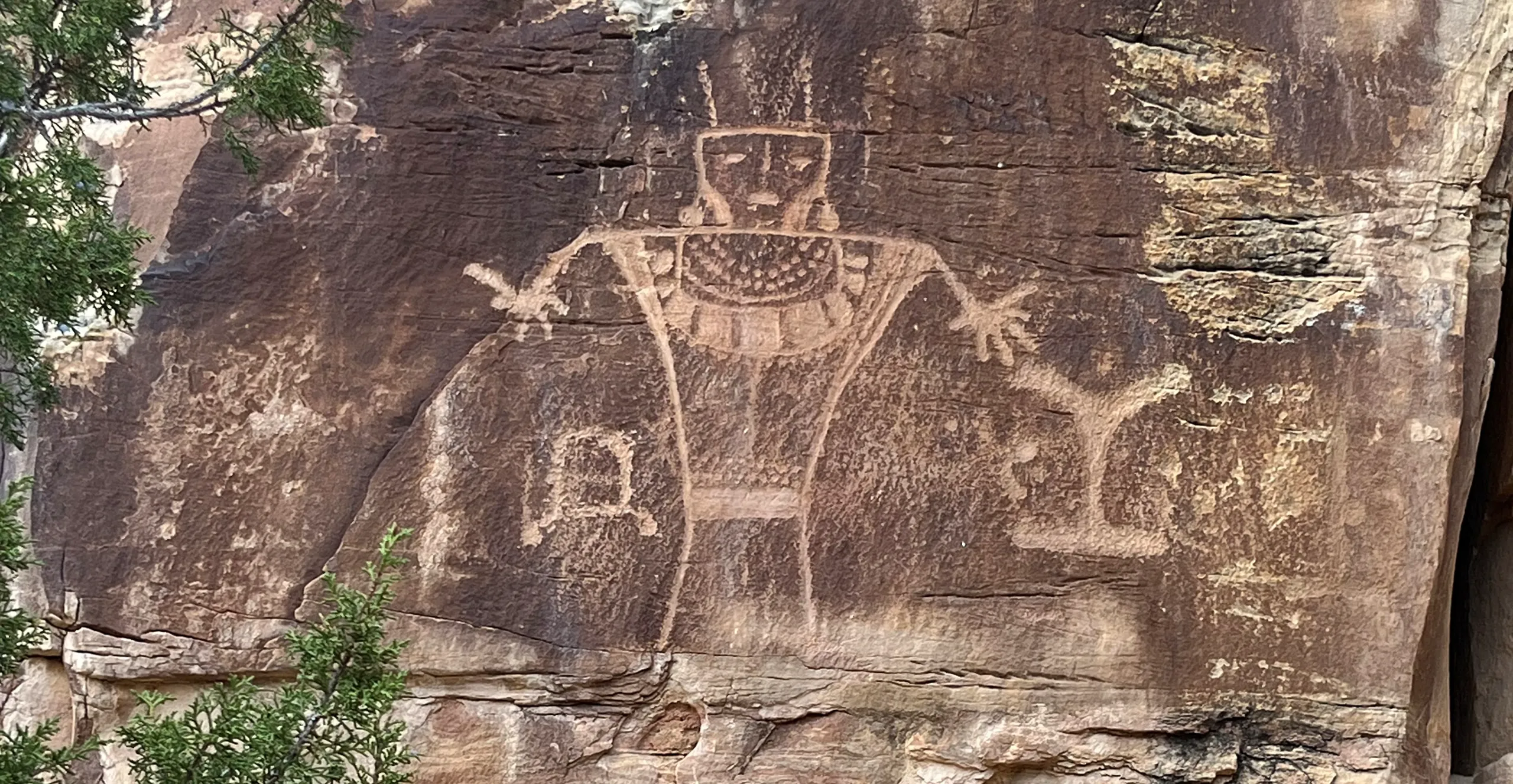
Only my dream backyard. It is a 500-acre ranch that has been in the McConkie family since 1935. There are several homes on the property that back up to the huge sandstone walls filled with ancient rock imagery. The site is called “McConkie Ranch Petroglyphs“, but you’ll see pictographs, too.

Can you imagine arriving at a cookout and your host saying, “Grab a drink and come out to the backyard”, and THIS is in the host’s backyard? I want to be invited to that cookout.
McConkie Ranch is designated a world class North American rock imagery site and is on the National Register of Historic Places.
Who Created the Rock Imagery?
The petroglyphs and pictographs are attributed to the indigenous Fremont people. The Fremont inhabited most of Utah and small sections of its bordering states between 1 A.D.-1301 A.D. Although the Fremont culture flourished along with that of their Ancestral Puebloan neighbors, the Fremont were a distinctly different people group.
Why call it rock imagery and not the more widely used term rock art? Find out on McConkie Ranch’s website under Rock Imagery Basics. Makes you think.
To learn more about the Fremont culture, visit the National Park Service website.


What Are Petroglyphs and Pictographs?
Petroglyphs are images that have been pecked into rock. Pictographs have been painted. You can find more detailed information about the differences in the National Park Service’s article “Learn to Look at Petroglyphs and Pictographs“.
Getting to McConkie Ranch
From Hwy 121, you’ll take Dry Creek Canyon Road until you reach McConkie Road. Punctuated by sandstone formations towering over homes and the high desert landscape, Dry Creek Canyon Road is my kind of country drive. The whole way I wondered, “Could I afford to move here?”
Once you turn onto McConkie Road (look for the McConkie Ranch sign) you’ll feel like you’re entering someone’s private driveway. You sort of are. Don’t worry, you’re in the right place.

Park in the designated parking area and head toward the small information building. This is where you can pick up a map and drop off the $10 per vehicle fee.
Even if you arrive and the information center is unattended (like it was when we arrived) be honorable. Leave the $10. The owners need visitor support to maintain the trails and security for the site.
Hike to the Rock Imagery
There are two trails you can hike to explore the rock imagery- Upper Main Panel Trail – 1 mile (1.6 km) round-trip and 3 Kings Trail– 1.5 miles (2.4 km) round-trip. Do both for the full McConkie Ranch experience.

Stay on the trails. The trails were rather snaky looking. Keep your eyes peeled.
We didn’t rate either trail as difficult, but they are rocky and require what I call light scrambling. You may consider the trails moderate to even challenging; it all depends upon your abilities and hiking experience. Just watch your footing and be careful along ledges.

This is an example of a janky area you must navigate to get closer views of the petroglyphs and pictographs.
Also, be aware of insects. There were a lot of pesky flying things along the 3 Kings Trail that drove us nuts. I’m not sure if these boogers are seasonal. If so, hopefully they aren’t in season when you visit.
Wear insect repellent!
And then there were the ants. Stand in one spot too long, and you might have them hitching a ride on your legs. Keep those feet shuffling! Maybe they are seasonally bad; maybe not.

Why would anyone want to deal with annoying insects just to see some dumb old petroglyphs? You gotta go to know. (And they aren’t dumb. They’re freaking awesome.)
Be Respectful!
Remember, rock imagery is irreplaceable. Once the images are damaged, they can’t be repaired.

Ooh, ahh, and point all you want, but never touch the images. That goes for rock imagery anywhere, not just McConkie Ranch. The oil from our skin accelerates deterioration.
This should go without saying but never add your own “art” to a rock imagery site. I’ve seen other sites trashed with people’s graffiti, some destroying indigenous art over 1,000 years old. Such a selfish thing to do. (And it’s illegal, so there’s that.)
Keep in mind we are guests on private property when we visit McConkie Ranch. Stay on the trails. There are families trying to go about their lives here. It’s a great privilege for us to be invited on their land to see such exquisite rock imagery. We should all want the site to remain accessible for future generations.

Commit McConkie to Memory
Before you head back down the trails, take time to stop and be in awe of all you’ve seen at McConkie Ranch. Commit it to memory. This place is special.

You don’t have to understand the history of the Fremont people or the meanings of the images or the science behind the formation of this canyon for deep appreciation of what you’ve seen.
Anytime life gets you down, remember standing on the cliffs at McConkie Ranch and how blessed you were to be there. You experienced something most people never will.
What Did My Husband Think About McConkie Ranch?
Sigh… He enjoyed the drive, the trails, and seeing the rock imagery. But… his opinion is, “If you’ve seen one petroglyph panel, you’ve seen them all.” I aggressively disagree. However, he did admit that for those who have never seen petroglyphs en masse, McConkie Ranch is a superb, stunning example of this cultural phenomenon.


What he enjoyed most though was knowing how happy I was to be there and seeing the wonder and excitement on my face. I love him for appreciating that. (Did you notice the two humanoid figures above me? They look like they are holding hands. Totally unplanned, but perfect!)
Coincidentally, he has the same opinion of caves that he does for petroglyphs. Again, I aggressively disagree. You can see a couple of examples of caves we’ve visited in my posts about Cathedral Caverns and Mammoth Cave. What do you think? Are petroglyphs and caves all the same? Let me know in the comments.
Care For More Ranch?
There’s another ranch I recommend you visit back in Vernal- the 7-11 Ranch Restaurant. The food was hearty, tasty, and well-portioned for the price.

You must, must, must order the scones. Nothing like traditional British scones, these 7-11 Ranch babies are homemade hunks of OMG tasting more like a sopapilla. We loved them so much, we got an order to go and ate them for breakfast the next morning. (I might have sneaked part of one that night.)
From the Library

When I began planning my 2025 road trip, I used the book Ancient Ruins and Rock Art of the Southwest by David Grant Noble to research rock imagery sites along the way. This is not a comprehensive guide, but still very helpful.
I recommend you research individual sites online before planning a visit. Public accessibility restrictions may have changed since the writing of Ancient Ruins and Rock Art of the Southwest. Also, getting to some of these sites may not be a trek you’re willing to make.
Comments