
“I hate the beach.” That was my old refrain. I couldn’t understand why all of my friends and family were bent on making annual pilgrimages to the ocean. And then I went to the Outer Banks.
The Outer Banks of North Carolina is where fell in love for shore. Or maybe I just finally met the right one.
Table of Contents
Why Did a Hater Go the Banks?
Not because I longed for the ocean. I went for the national parks. There are three National Park Service sites in the Outer Banks. Where there are National Park sites, there are Junior Ranger badges. I went to the Banks for the badges.
And my husband loves the beach, so there’s that.
What are Junior Ranger badges? Only my not-so-secret national park addiction. For all you need to know about the Junior Ranger program, check out my post Junior Rangers Never Get Old.
I decided I could suffer a boring beach for a few days to add those coveted Junior Ranger badges to my collection. And the lighthouses might be interesting.

What are the “Outer Banks”?
The Outer Banks (or “OBX” as locals refer to them) are a chain of narrow barrier islands protecting the coast of mainland North Carolina from the constant, violent pounding of the Atlantic Ocean. And when I say “narrow”, I mean really narrow. Like one mile (1.6 km) wide at the widest narrow. You might even say unsettling narrow when you visit the islands for the first time.
The Outer Banks barrier islands also protect a portion of Virginia’s coast, but most people associate the Outer Banks with North Carolina.
Why You Should Visit the Outer Banks
This is a place as much about darkness as it is light. Revelation and revelry. Gossip and truth. Tales of pirates and shipwrecks and stolen souls. Where the lost and the found are equally at home. I’m not waxing poetic. The Outer Banks are poetic. You’ve gotta go to know.

When to Visit
Any time depending upon what you seek. We went in mid-May, but this is what you can expect throughout the year in the Outer Banks.
- Summer- Higher temps, biggest crowds, highest lodging prices, all businesses/attractions are open
- Fall- Comfortable to cool temps- lower crowds, lower lodging prices, off-season begins, many businesses/attractions begin closing
- Winter- Lowest temps, low crowds, lowest lodging prices, many businesses/attractions closed
- Spring- Comfortable temps, lower crowds, higher lodging prices, seasonal businesses/attractions begin to reopen
We visited at the tail end of the off-season. The temps were comfortably cool in the mornings and warm the rest of the day. The water was cold, the waves rigorous, the riptides stealthy.

Where We Stayed
From Airbnb rentals, local and chain motels, and resorts, we found lots of lodging choices in a wide range of prices. But we found exactly what we were looking for at Outer Banks Motel on Hatteras Island.

This somewhat updated, less-expensive, no-frills property has a small pool and a laundry facility on site. Our standard room had an enclosed porch where I spent my mornings drinking coffee, reading, and listening to the waves. We could only see a sliver of the ocean from our room, but more expensive units with full ocean views were available.

The Outer Banks Motel’s biggest selling point (for me) is its proximity to historic Cape Hatteras Light. A short walk along the beach takes you to one of the most iconic lighthouses in the world.
Because the high season hadn’t kicked into gear, many seasonal dining/shopping options on Hatteras Island were still closed in mid-May. That wasn’t a problem for us. With a few microwave meals purchased at a local grocery story and Angelo’s Pizza within walking distance, we made do.
For more dining and shopping options, consider staying in Nags Head, Kill Devil Hills, Kitty Hawk, or even farther north in Duck or Corolla. I loved the village vibe of Corolla. We plan to stay there on our next trip to OBX.
What to Do in the Outer Banks
You’ve got lots of choices. Here are just a few.
Cape Hatteras Light
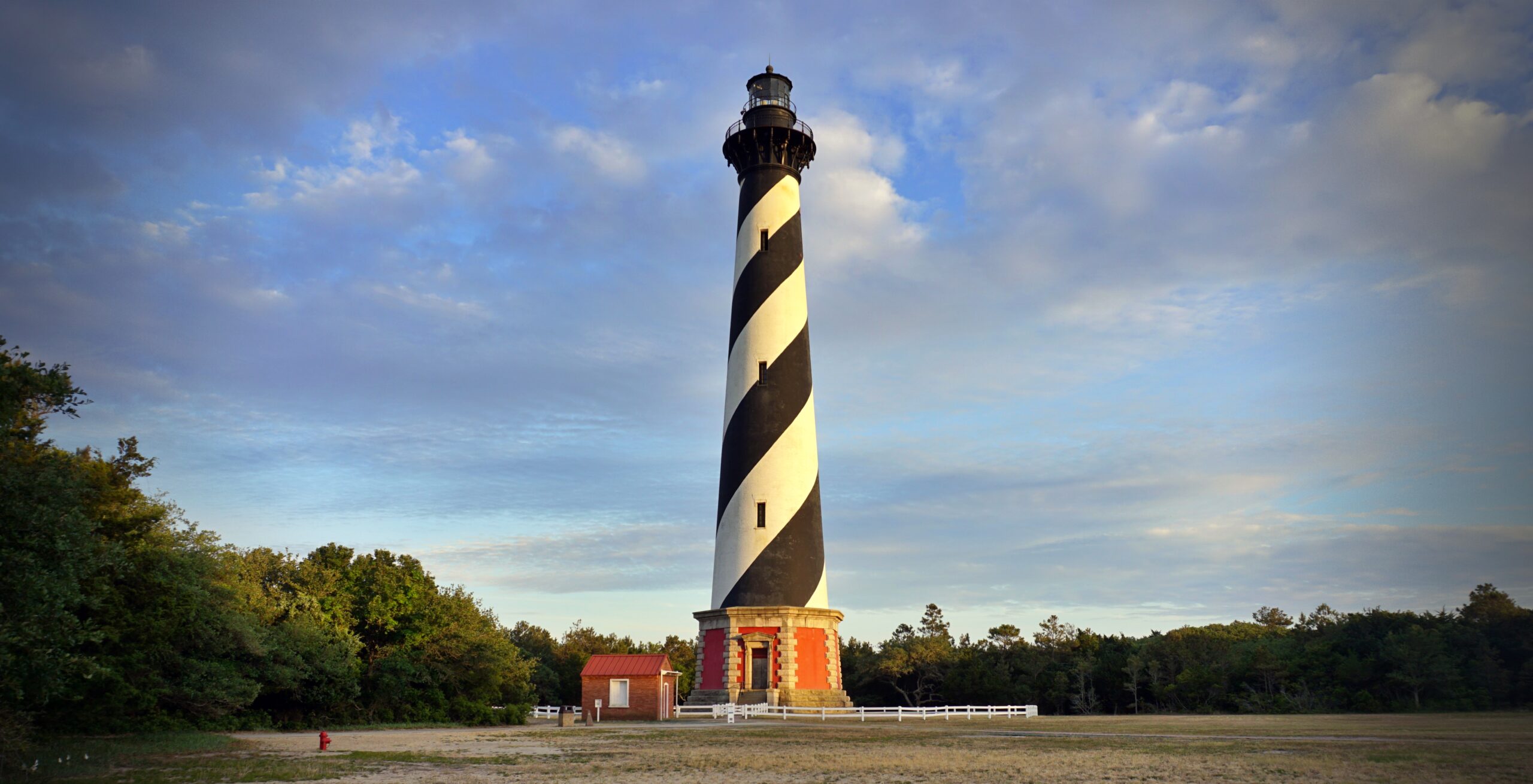
If you don’t visit another lighthouse in the Outer Banks, you must see Cape Hatteras Light. To me, Cape Hatteras Light and its story define the character of these islands. I recommend attending a ranger program focusing on the light’s history. It was one of the most interesting we’ve ever attended in the national parks.
Can you climb Cape Hatteras Light? Not in 2025. The 190-foot-tall lighthouse is undergoing restoration, and climbs will be unavailable until the work is complete. Don’t worry though. Even if you can’t climb it, the up-close view, the keeper’s home, and the grounds are still worth exploring, especially in the hours before sunset when the colors of the lighthouse are most stunning.
Check the Cape Hatteras Light Station’s event calendar, including ranger programs and lighthouse climbs.

Did you know Cape Hatteras Light hasn’t always been located in this spot? In 1999 the lighthouse was moved intact to where it stands today after the lusty Atlantic threatened to steal it from the shore. In an effort to save the lighthouse, the government passed legislation to move it 2900 feet inland. The process took 23 days.
You’d think Cape Hatteras would be forever safe from future plunder, but it isn’t. Since the move in 1999, Cape Hatteras Light is 1400 feet closer to the water’s edge. 1400 feet of ground lost in less than 30 years! The Atlantic never gives up. There is no doubt this lighthouse will have to be moved again if it is to be preserved. Can it withstand another move? Some of us may see.
Bodie Island Light
Bodie (pronounced “body”) is a charming 156-foot-tall lighthouse overlooking the Atlantic Ocean to the east and Pamlico Sound to the west. We booked a ranger-led tour that included a climb to the top. Tours are offered during late spring-early fall (April-Oct. in 2025) and require online reservations. Tickets can only be purchased the day of your tour. Make reservations as soon as tickets become available at 7:00 AM. Tours may sell out within minutes.


I was most interested in seeing Bodie Light’s first order Fresnel lens.
French Physicist, August-Jean Fresnel developed his groundbreaking lens in 1822. Constructed with hundreds of pieces of glass fitted in concentric patterns, the Fresnel lens creates an intense beam that can be seen far out in the ocean. Bodie’s light can be seen for 19 miles!
Fresnel was more than a legendary physicist. He was an artistic genius whether he knew it or not. The lens reminded me of a modern art piece fit for a museum.
Currituck Beach Light
Currituck Beach Light is located in the northernmost Outer Banks in the historic city of Corolla, North Carolina. Built in 1875, the 162-foot-tall Currituck Light is a charming red brick beacon with a 220-step staircase you can climb to the top. It’s a workout for your legs, but the reward is worth it. The narrow outdoor balcony at the top of the lighthouse affords an unobstructed view of Currituck Sound and the Atlantic Ocean as well as the giant live oaks dotting Historic Corolla Park below. Beautiful.


Like Bodie, the Currituck Beach Lighthouse also uses a Fresnel lens that continues to keep sailors safe today. The light is turned on at dusk every evening if you want to see it in action.
For more information about planning a visit to Currituck Beach Light, check out the park’s website.
There is so much to do in the Currituck area. For ideas, visit Corolla Resort’s website.
Cape Hatteras National Seashore
The national seashore was established in 1958 to protect 70 miles (113 km) of natural beauty and treasured history. This is prime fishing area drawing recreational fisherman from far and wide. Beaches are natural, mostly undeveloped, and host a variety of migratory birds in addition to coastal prairie vegetation and three of the most visited lighthouses in the Outer Banks (Cape Hatteras, Bodie, and Ocracoke Lights).
For more information about fishing in Outer Banks, visit the Fishing Booker website.

Look for pullouts along NC Hwy. 12 to explore the beach. Bring a blanket and a picnic. A good book would be nice, too. If you didn’t bring a book, I’ll tell you where to find one. Keep reading!
Just a side note- think twice before drinking the water from the National Park Service bottle-filling stations. The tap water in Outer Banks was the worst I ever tasted. I recommend buying jugs of spring water to refill your bottles.
Ocracoke Island
Ocracoke Island is a historic gem with quaint shops, a nature preserve, and an award-winning beach with the Ocracoke Light overlooking it all. You’ll find all kinds of recreational activities including kayaking and wildlife-watching available on this casual, remote island. In 2024, Ocracoke Island was named the best island to visit in United States by HGTV.
The only way (for your average budget-conscious traveler) to get to Ocracoke Island is by ferry and that’s the reason we didn’t go. I have a tendency to get seasick, and I was advised the water may get choppy on windy days. It was very windy when we were there. If you’re okay with a possibly choppy ride, go for it!
There are two ferries- one that accommodates bikes and passengers and one that accommodates passengers and vehicles. Check the North Carolina Department of Transportation’s website for more information about ferry schedules and pricing.

You can also get to Ocracoke Island by air. If you have the budget to charter a flight, be boujee.
Touring Ocracoke by bike is considered an ideal way to tour the island. A multi-use path runs throughout and bike racks can be found at most shops and restaurants.
Biking Ocracoke didn’t work out for me this time, but maybe I’ll get another chance someday. Why can’t I just close my eyes, click my heels, and be in Ocracoke?
Wright Brothers National Memorial
I never expected to enjoy Wright Brothers National Memorial as much as I did. The story of the Wright Brothers and their numerous failures on the way to one of the greatest feats in American history is fascinating. Don’t miss learning about the role their sister played in the brothers’ journey to success.

The Memorial includes an excellent museum and gift shop, a walking trail, an impressive Art Deco granite monument dedicated to Wilbur and Orville, and my favorite- the outdoor bronze and steel sculptural recreation of the Wright’s first successful flight.

Wright Brothers National Memorial is worthy of its own post. I’ll write one soon.
Go Fly a Kite
On a whim, I decided to buy a kite for this trip. Turned out to be the perfect idea, because May is one of the best times to fly a kite in the Outer Banks. Talk about some strong wind!

Don’t have a kite? You’re in luck, because Kitty Hawk Kites located in the Outer Banks has a huge selection of really cool designs you won’t find in your average toy/hobby shop. Kitty Hawk Kites has several brick-and-mortar locations in OBX as well as online shopping. I wish I had waited to buy my kite at Kitty Hawk!
Kill Devil Hill, at the Wright Brothers National Memorial, is the most popular spot for flying a kite in the Outer Banks. The Wright Kite Festival is held every year at the site of the Wright Brothers first flight. You can watch professionals, fly your own kite, and even get free kite-flying lessons. I hate we missed this!
For more information about the annual Wright Kite Festival, to Kitty Hawk Kites events page.
Fort Raleigh National Historic Site
This site was a last minute add-on to our trip. Located in Manteo, NC approximately 42 miles (66 km) from Hatteras Island lies the remains of the first English colony in America, also known as the “lost colony“. The museum was worth a quick visit, and we enjoyed learning about the various cultural groups that inhabited the area. Take a ranger-led tour if you have time.

The “lost colony” refers to the English settlers who came to Roanoke Island in 1587. The leader of the expedition returned to England for supplies and when he returned to the island, the settlers were gone without a trace. Their disappearance remains one of the greatest unsolved mysteries in American history.
If you have time, visit the Elizabethan Gardens for a stroll and if you’re visiting in the high season, check out The Lost Colony outdoor drama. The rangers and locals gave it high praise. Unfortunately, The Lost Colony wasn’t being performed while we were there. It typically runs at the end of May through August.
Watch Kiteboarding at Pamlico Sound
On an early evening drive around Hatteras Island, we spotted people soaring through the air like pelicans over Pamlico Sound. They appeared to be parasailing without boats, but what they were actually doing was kiteboarding– a combination of surfing and paragliding.

You’ll find several popular spots along the beaches of Pamlico Sound to observe kiteboarders’ mesmerizing aqua/aerial acrobatics. Salvo Day Use Area on Hatteras Island had the most parking and amenities. I recommend stopping at sunset when the gilded kites appear like suspended jewels over the Sound.
Go Shelling
I’ve never enjoyed shelling more than I did at Cape Hatteras National Seashore. I brought in a haul! Even though I found many intact shells including numerous large conchs, I was more enchanted by the fragments. So thick and colorful, these wave-battered pieces could easily be mistaken for Native American potsherds. (Or maybe that’s my overactive imagination. I love the Pueblo pottery of the ancient American southwest.)

I filled a 3-gallon bucket with shells while walking the mile from our motel to Cape Hatteras Light. What am I going to do with three gallons of shells? That’s a good question.
Bike the Outer Banks
The Outer Banks are a biker’s paradise with numerous multi-use trails to explore. We took our beloved beach cruisers, but there are several bike rental companies throughout the area if you don’t have your own. For more about biking the Banks, visit www.outerbanks.org.
Try the Famous Apple Ugly

An apple fritter is the last thing I’d normally order at a bakery. Fritters just aren’t my jam. But when I heard Orange Blossom Bakery claimed to have the best apple fritter or “Apple Ugly” in OBX, I had to try one. Take it from me, Orange Blossom has every right to brag. OMG.
Besides being enormous, Apple Uglies have perfect texture, a generous amount of apple cinnamon filling, and a glaze that takes the whole thing over the top. I’ll take an Apple Ugly over a donut any day!
Get to Orange Blossom early. Apple Uglies often sell out.
Buxton Village Books
Buxton Village Books in Buxton, NC is a cute, coastal gem of a bookshop any bibliophile will adore. You’ll find shelves stuffed with new and used titles mingled with a selection of unique gift items. I was dying to buy a Sea Bags tote made from recycled sails, but they were a bit out of my budget. Sigh.
I especially like Buxton Village’s spotlight on local authors and books set in the Outer Banks. David Payne’s books were featured front and center. I scored a like-new copy of his Gravesend Light for just $6. See From My Library below.
Witness the Unrelenting Power of Erosion
There is no better place in Outer Banks to see the unrelenting power of erosion than the beach in Rodanthe, NC. Several homes have been swept away by the hungry waves of the Atlantic; their dramatic demise being captured on videos like this one posted by local television station WRAL. Pretty scary.
While driving through Rodanthe, we saw a home partially fallen and reduced to flotsam bobbing in the waves. I couldn’t help but wonder about all the memories made and storms weathered in that home over the years. How many honeymoons, family reunions, anniversaries, and birthdays had those walls hosted? How many secrets had they heard? Would the owners ever rebuild their dream? My mind traveled all kinds of places.

If you’ve seen Nights in Rodanthe starring Richard Gere and Diane Lane, a movie based on the Nicholas Sparks’ novel of the same title, you’ll remember the iconic home where the story took place.
Like Cape Hatteras Light, the Nights home was doomed to destruction by the encroachment of the Atlantic. In 2010, the home was moved about 1/2 mile from the shore by the same company that moved Cape Hatteras. The home now resides on Beacon Street in the city of Rodanthe on Hatteras Island.
Since the move, the Inn at Rodanthe (which is actually a single-family home, not an inn) has been restored to its cinematic state and is a popular vacation rental. Visit Surf or Sound Realty for booking information. If you stay there, please let me know what you think.
Efforts are being made in the Outer Banks to combat erosion by a process known as “dredging”. There are plenty of arguments for and against dredging that you can read about on your own. I wrote my poem Plundered after listening to a geology lecture and learning about the history of piracy in the Outer Banks.
Will I Go Back to the Outer Banks?
You can bank on it. Maybe I’ll even brave the ferry ride to Ocracoke. I’m looking forward to spending more time on my next trip biking in the northern Banks and diving more into why OBX is known as the “Graveyard of the Atlantic“. There’s so much more to see and do in the Outer Banks than I ever imagined! I hope I’ve encouraged you to make the Outer Banks your next beach destination.
“The one person in the world who I was born to love forever. A person, like me, of the outer banks and the blue Atlantic mystery. A person rich in simple treasures. Self-made. Self-taught. A harbor where I am forever home. And no wind, or trouble or even a little death can knock down this house.”- Message in a Bottle
Photo attribution:
Nights in Rodanthe home: Wendy, CC BY-SA 2.0 https://creativecommons.org/licenses/by-sa/2.0, via Wikimedia Commons


Comments