
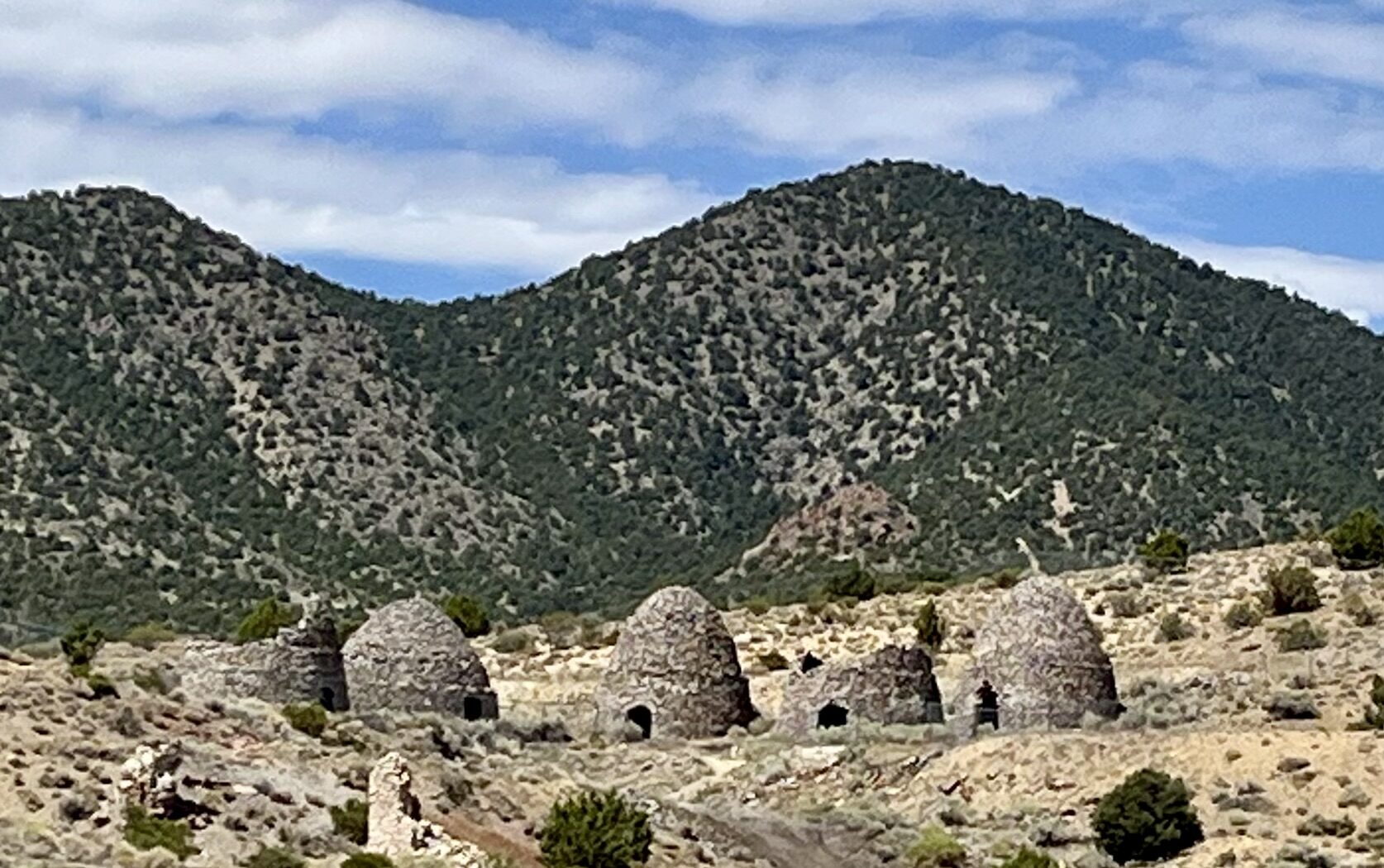
My husband spotted them a few days ago in Frisco, Utah as we were driving from Beaver toward Nevada on Utah State Route 21. Sitting far back from the road on a hillside were five stone buildings he thought might be ancient Native American dwellings. I caught a glimpse as we passed and said, “Those aren’t dwellings; they’re ovens.” I got excited.
I recognized the beehive shape of the buildings from pictures I’d seen of charcoal kilns (ovens) used by old mining companies.
Then I saw a sign indicating a roadside historical marker was just up ahead. We pulled over to read a diminutive plaque identifying the area as Frisco, a mining town established after prospectors discovered a whole lot of silver in 1875.
Sounded interesting. My husband said he saw a dirt road leading toward the kilns, so we decided to turn around and see if we could get a closer look.
Oh, there was a road all right. A washboarded, rocky, dipped, dirt road that I prayed wasn’t about to destroy my brand-new car. We drove about halfway to the kilns before deciding it best to explore the site on foot.
We had NO idea whether or not we were trespassing. There was no “Keep Out” or “Private Property” sign by the road, so we assumed it was public land. I don’t recommend proceeding on assumption like we did. Thankfully, it worked out for us, and we found out later it was okay to visit. However, this site is NOT public land.
Unlike the kilns at Nevada’s popular Ward Charcoal Ovens State Historic Park, you can’t enter Frisco’s kilns. After being deemed structurally unsound, a fence was installed around the Frisco kilns to deter visitors from entering and possibly getting injured. I wasn’t too disappointed. It was hot as an oven outside and I didn’t want to walk 150 yards just to stand by the fence and look in. Besides, this was supposed to be a quick stop. We had to get to Great Basin National Park in Nevada that afternoon.
As we headed back to our car, we realized there was more to this site than the kilns. There was rusty mining equipment scattered everywhere along with the remnants of buildings and a road leading to a cemetery. An honest-to-God ghost town. I was intrigued.

Intrigued enough that the following night after a long day in Great Basin National Park, I began a little online digging into the history of Frisco. Turns out, the historical marker left out the best parts of the town’s story. Here are a few things I learned.
.
- Two average joe prospectors stumbled upon silver here in 1875. They wanted to turn a quick buck and sold their claim for what they thought was a good price. Eventually Horn Silver Mines took ownership and the mine became the most profitable in the country. According to Horn Silver Mines, Inc. website, the Frisco mine produced gold, silver, zinc, copper, and lead worth $300,000,000 in today’s market. Don’t you know those original prospectors were kicking themselves for selling so cheap.
- Frisco, Utah was the wildest 19th century boomtown in the American West. Murders occurred daily. (Move over Tombstone. Why hasn’t there been a blockbuster about Frisco?)
- There was so much lawlessness in Frisco that a sheriff from Pioche, Nevada, notorious for his heavy hand of justice, was hired to bring order to the town. He wasted no time in doing so. Sheriff William Pearson killed six rabble rousers his first day on the job. He had a “no arrest” policy. He was more of a “get in line or get shot” kind of lawman. What’s surprising is he had to kill others after that! I guess some people weren’t too quick on the uptake.
- In 1885, the Horn Silver Mine did suffer a cave-in like the marker stated, but shockingly no one got hurt. The cave-in occurred between shifts. How ironic is that?
- Horn Silver Mines, Inc. still owns the mine (at least in part) and continues to explore its resources. The company believes a substantial amount of ore may still exist in the Frisco mine.
The Horn Silver Mine itself cannot be visited. There are obvious “No Trespassing” signs in that area. Old mine shafts are dangerous, not only because of possible cave-ins, but because poisonous gases are often found around their entrances. I’m not sure what’s being emitted from Frisco, but it’s not worth the risk of trespassing to find out.
Was Frisco worth a stop?
Definitely. Seeing it made me wonder how many of those bronze historical signs I’ve overlooked in my travels that mark something as significant and interesting as the history of Frisco. How many are in my own town? I’m sure there are many I’ve passed hundreds of times and still know nothing about. Maybe I need to do a little digging in my own backyard. I might just stumble upon a gold (or silver) mine of my own.