
In the vast prairie farmlands of southeast Nebraska, Homestead National Historical Park invites travelers to immerse themselves in an American claim to fame- the Homestead Act of 1862. This historic piece of legislation signed into law by President Abraham Lincoln helped make the American dream of “Manifest Destiny”, even more of a reality and the United States even more united. Thomas Jefferson would have been pleased.
What is Manifest Destiny?
American entitlement. “We’re loud and proud and deserve to have it all.” That’s Manifest Destiny in a nutshell.
What Did the Homestead Act of 1862 Do?
It allowed the government to give away land. Almost any American citizen could be granted 160,000 acres of free land west of the Mississippi River upon meeting certain conditions. The fact the land was stolen didn’t seem to matter at the time.

What Did It Take to Get This Free Land?
A huge leap of faith. A small filing fee. A difficult and sometimes treacherous journey. A drastic change of scenery. Isolation. The marginalization of Indians. Scarcity. Fear of failure and five years of toil. Doesn’t sound so free to me.

Before I visited this lesser-known park in Beatrice, Nebraska, I was conflicted about the Homestead Act. Would I have supported Manifest Destiny in the early days of our country? Do my actions support it now?

I went to Homestead National Historical Park to sort some things out and after spending three hours there, I left with a few answers.
I am fascinated by the history of indigenous tribes and believe what America did to remove them from their homelands was morally wrong. But I also recognize the Homestead Act spurred our country to become what it is today, a country I’m proud to call home.
Homestead National Historical Park Heritage Center
The Heritage Center is where I suggest you spend the bulk of your time if you have less than three hours at Homestead National Historical Park. There is so much to see here and the gift shop’s pretty good, too. It’s also where you’ll find maps, Junior Ranger books, and National Park Passport stamps.
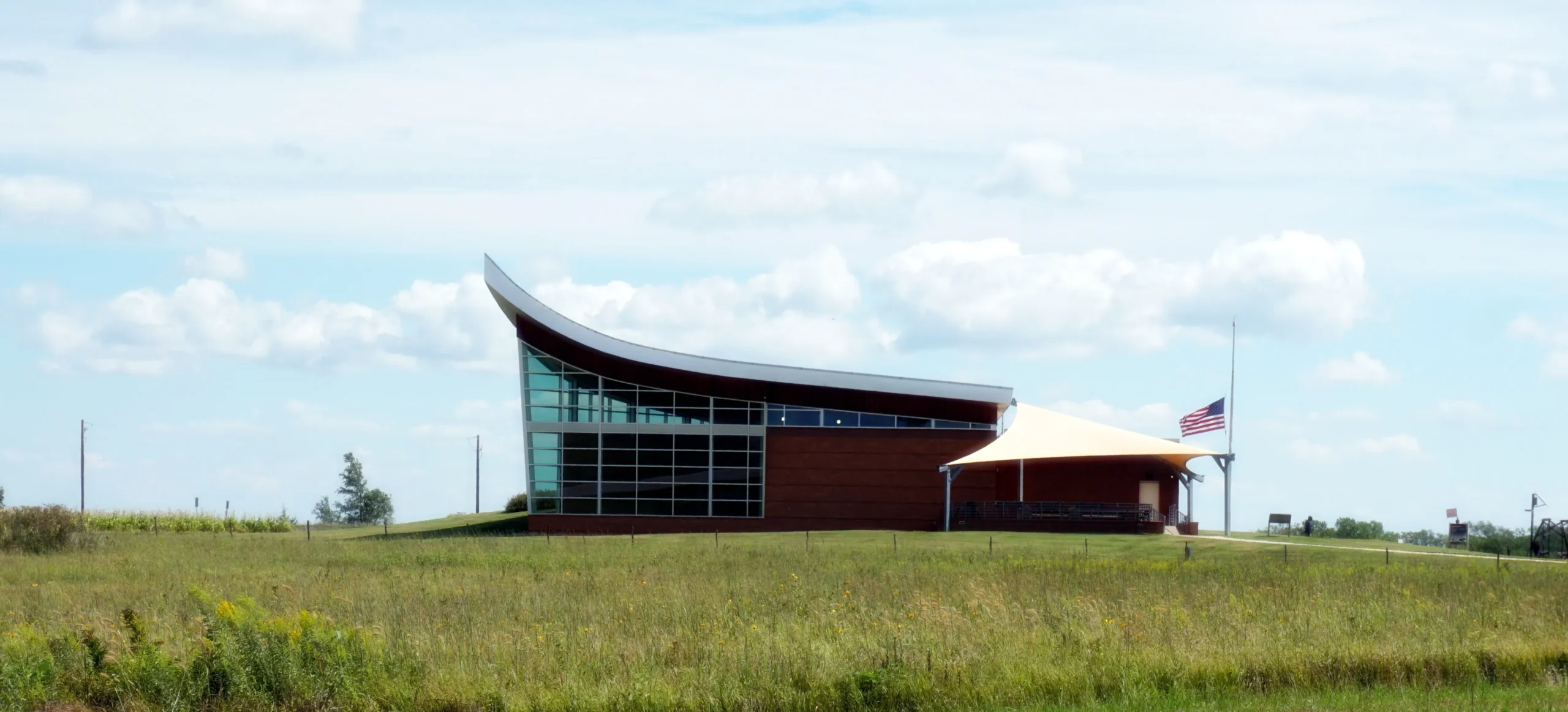
Does the shape of the Heritage Center look familiar? It didn’t to me. But then I’m not a farmer. Don’t really know any farmers. And I sure as heck have never been interested in farm equipment. I just thought it was a cool building.

Later, I found out the Heritage Center was designed in the shape of a plow. The tool that broke the land and the backs of the people breaking it. One of the most important tools in a homesteader’s shed. This building isn’t just cool; it’s architectural genius.
Begin with the Living Wall
You’ll start your tour of the Heritage Center before you even get to the door. Notice the state plaques hanging on the rock wall. The square openings represent the amount of land granted under the Homestead Act between 1862 and 1979. That’s a lot of land! About 270 million acres, actually.

I found it amazing anyone wanted to settle in Alaska. Can you imagine being from east of the Mississippi River and making that change? Even more amazing is the last deed under the Homestead Act wasn’t issued until 1988. It was for property in Alaska. You’ll find the story about that claim in the Heritage Center museum.
Tour the Museum
The museum’s maze of exhibits outlines the history of the Homestead Act from its creation to its end with all the good and bad in between. I gained a whole new appreciation for those homesteaders who settled for extreme hardship to prove their self-sufficiency. How many of us would make that choice today? Plan to spend 45 minutes in the museum, but you may find yourself wanting to stay longer.

Before visiting the Homestead National Historical Park museum, I never thought about how machinery like looms or washing machines were powered in the “old days”. In this photo, a goat is walking on a treadmill to power a butter churn. This was one of my favorite exhibits.
Watch the Park Film
If you’re short on time, take a quick walk through the museum and watch the 23 minute park film, “Land of Dreams- Homesteading America”. The film will give you a good overview of the significance of the Homestead Act.
Claim Your Family History
Think you might have a family connection to the Homestead Act? Find out at the genealogy research stations in the Heritage Center. Park rangers are available to help you navigate the digitized records.

Earn Your Homestead Junior Ranger Badge
I earn Junior Ranger badges at every National Park Service site I visit. Completing the workbooks makes every park more memorable. And Junior Ranger badges aren’t just for kids! At Homestead National Historical Park, you can earn a “Not So Junior Ranger” badge. But be prepared! The adult book requires a lot more effort. You’ll be even more proud of that badge when you’re finished.
What’s Junior Ranger? Find out about it here.
But Wait, There’s More to See!
Homestead National Historical Park has a lot more to see outside the Heritage Cener. We enjoyed a walk along the Osage Trail, peeking inside the 1867 Palmer-Epard Cabin, and a ranger talk at the Freeman School. You’ll find a map of these sights and more on the park’s website.


Catch a ranger talk at the Freeman School if you can. It was a highlight of our visit. The ranger was so knowledgeable about the school’s history and really brought its story to life. Can you believe this one-room schoolhouse was used until 1967?
Final Thoughts about Homestead National Historical Park
I think a lot of us would have taken the opportunity offered by the Homestead Act of 1862. We would have acted in the best interests of our families’ futures and left everything we knew behind. We would have chased that American Dream until we caught it or died trying. And as much as I hate to say it, I think a lot of us would have done it at the expense of indigenous tribes without any sense of guilt. Today, we know that to be an ugly truth.
But we should also recognize this truth. Our United States did become more united by the Homestead Act. We became the Land of Opportunity, a land that invited immigrants and the formerly enslaved to enjoy a piece of American pie. There is freedom in making one’s own way, and a lot of people found that freedom because of the Homestead Act.
After visiting Homestead National Historical Park, I can tell you this. I still enjoy watching Little House on the Prairie. I still despise the wrongs our government perpetrated on indigenous tribes. And I still love the United States.
If you find yourself in southeast Nebraska, make time to see Homestead National Historical Park. I’d love to know what you think about it.
If You’re Hungry After Homestead National Historical Park
You’ve got to get to Runza and try one of their signature stuffed sandwiches. This Midwest born and bred sandwich shop gives other chains a serious run for their money. You’ll find Runza restaurants scattered throughout Nebraska, but you’re in luck! There’s a Runza located just 6 miles (9.7 km) from the Homestead National Historical Park Heritage Center in the town of Beatrice. Try the Original Runza with beef, cabbage, and onions. Sounds strange, but I promise it’s delicious! We hit the road fat and happy.

From the Library

O Pioneers! by Willa Cather is a classic. It’s the story of the American dream made possible by the Homestead Act of 1862. A dream gone wrong for some, right for others, easy for none. This work of historical fiction set in early 20th century Nebraska includes themes of love, grief, jealousy, and female empowerment.