
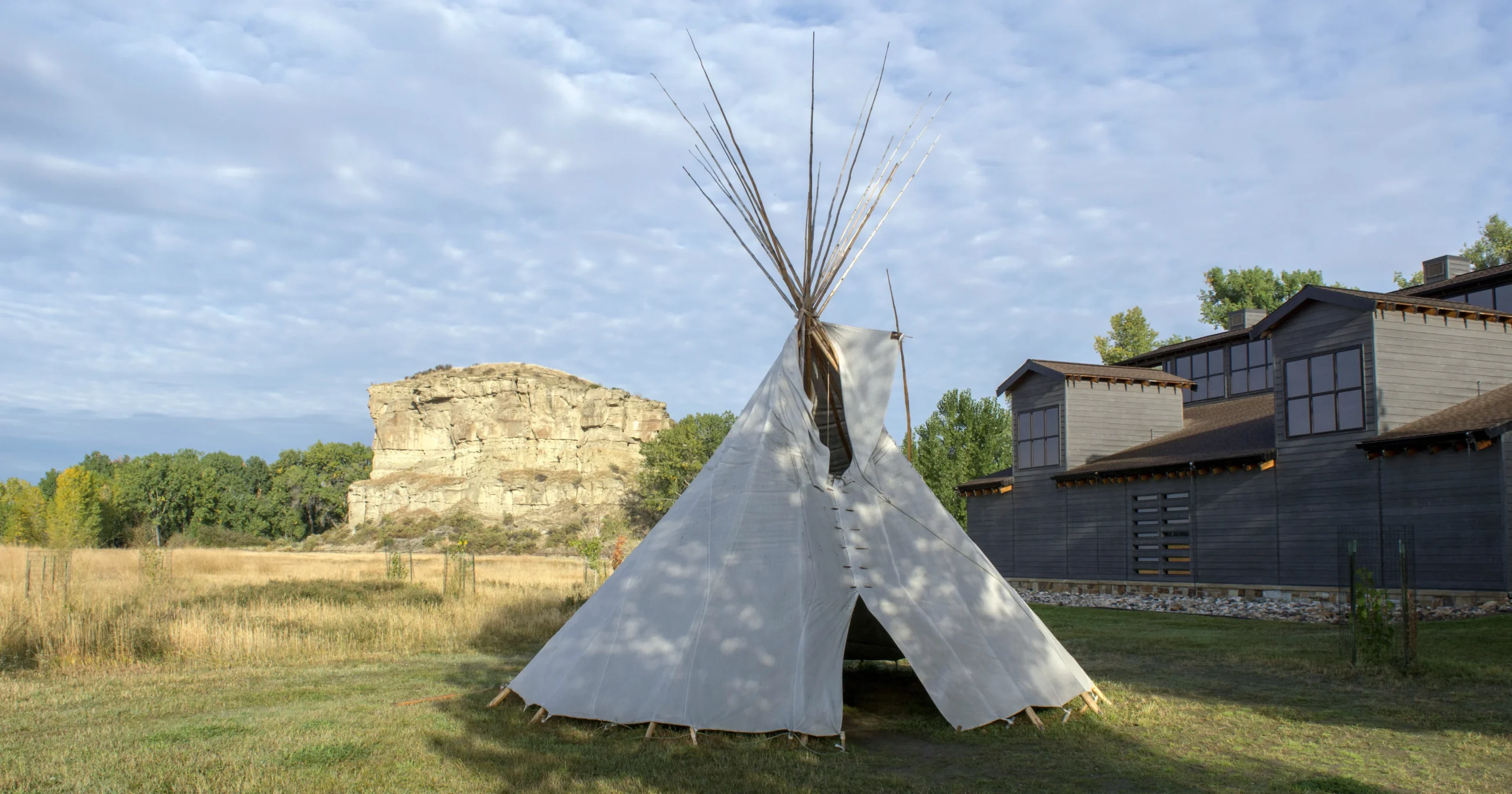
It was 2018 and we were on a mad dash from Glendive, Montana to Yellowstone National Park. Our only planned stop was a grocery store in Billings. But our plan changed when we saw a big brown sign for a national monument on Interstate 94 at Exit 23. We passed the exit but immediately regretted the possibility of missing something awesome. So, we turned around. And that’s how we discovered Pompeys Pillar National Monument on the Lewis & Clark National Historic Trail in Montana.
I’ve been interested in Lewis & Clark history far longer than I’ve been interested in national parks. I couldn’t believe I’d never heard of Pompeys Pillar. It’s one of the most significant sites on the Lewis & Clark Trail!
What Is Pompeys Pillar?
The pillar is a giant 150-foot sandstone monolith along the Yellowstone River discovered by Captain William Clark on his return trip from the Pacific Ocean. Clark named the rock “Pompys Tower” in honor of Pomp. Later, the first editor of Lewis & Clark’s famous journals took it upon himself to rename the rock “Pompeys Pillar”. (Either way, there’s no apostrophe in the name.)
My brain goes haywire every time I don’t see the apostrophe. Spellcheck does not approve!

Who Was Pomp?
“Pomp” was the nickname of Jean Baptiste Charbonneau, son of Sacajewea and Toussaint Charbonneau. Sacajewea was the legendary Shoshone woman who served as an interpreter between the Lewis & Clark party and the indigenous tribes they encountered along the way. William Clark became so fond of Pomp that he treated him like a son. The fact Clark named the monument after the little boy instead of himself speaks volumes about his devotion.
Why Is Pompeys Pillar Significant?
When you visit Pompeys Pillar, you can stand in the footsteps of William Clark. How do you know for sure? In 1806, William Clark signed his name right on the rock and he wrote about doing it in his journal. His signature is the only intact physical evidence that remains as proof of the route Lewis & Clark took on their 1803-1806 expedition. You can see it for yourself on the trail to the top of the monument.
You serious Clark? Yes.

What To Do at Pompeys Pillar
Visit the Museum
If you aren’t familiar with the Lewis & Clark expedition, the museum will give you some background about their journey. Staff encourage you to ask questions. You can get your National Park Passport book stamped inside the museum, too!

Hike to the Top of Pompeys Pillar
Take a ranger led hike to the top of Pompeys Pillar if you can. Rangers provide so much more information than you’re likely to learn on your own.
The trail to the top of the rock is short but steep. Be prepared to climb a lot of steps. I promise the view is worth the effort.
Besides the signature of Captain William Clark, you’ll see the signatures of other travelers and petroglyphs carved by the indigenous people once inhabiting the area.

Once we reached the top, the ranger told us to look out over the plain below. When William Clark stood here in 1806, he saw immense herds of buffalo and elk along with wolves. You won’t see immense herds of anything here anymore. It wasn’t long after Lewis & Clark opened the west that hunters showed up and butchered buffalo to near extinction. The herds have never fully recovered.
Walk to the Yellowstone River
Take an easy, peaceful walk to the Yellowstone riverbank. Enjoy a picnic. Admire the geology. Give thanks for having the opportunity to see this place for yourself.

Pompey Wrap-Up
No, Pompeys Pillar isn’t the biggest geological wonder. You may not even find it the most impressive. What makes it worth seeing is its cultural significance and the proven physical record of the Lewis & Clark journey- a record you won’t find anywhere else.

Whether you know a lot about the Lewis & Clark expedition or not, this site is an important reminder we are all explorers in this incredible wonder we call America. There’s so much more to see than we can ever imagine. Get out there. Take a detour now and then!
For more about Pompeys Pillar, including hours of operation and admission fees, visit the Bureau of Land Management website.
I recently discovered a historic site dedicated to Meriwether Lewis, William Clark’s partner in the expedition. The Meriwether Lewis Site is not located on the Lewis & Clark National Historic Trail. It’s located in Hohenwald, Tennessee and is the site of Lewis’ mysterious death. Check out my article Meriwether Lewis Site- The Great Mystery on the Natchez Trace for more about that historic hidden gem.
From the Library

Sacajawea is a legend. She was instrumental in the success of the Lewis & Clark expedition. But how much do we really know about her?
Debra Magpie Earling’s historical fiction The Lost Journals of Sacajawea tells what many historians believe is Sacajawea’s true story- the violent theft of a young girl’s innocence by men seeking immortal fame. Written in a style like none other I’ve read; the book incorporates what I considered awkward word pairings and grammar along with unfamiliar cultural concepts all of which would have been fully understood by indigenous people at the time. I think the author meant for us to hear Sacajewea’s story rather than simply read it.
Comments