
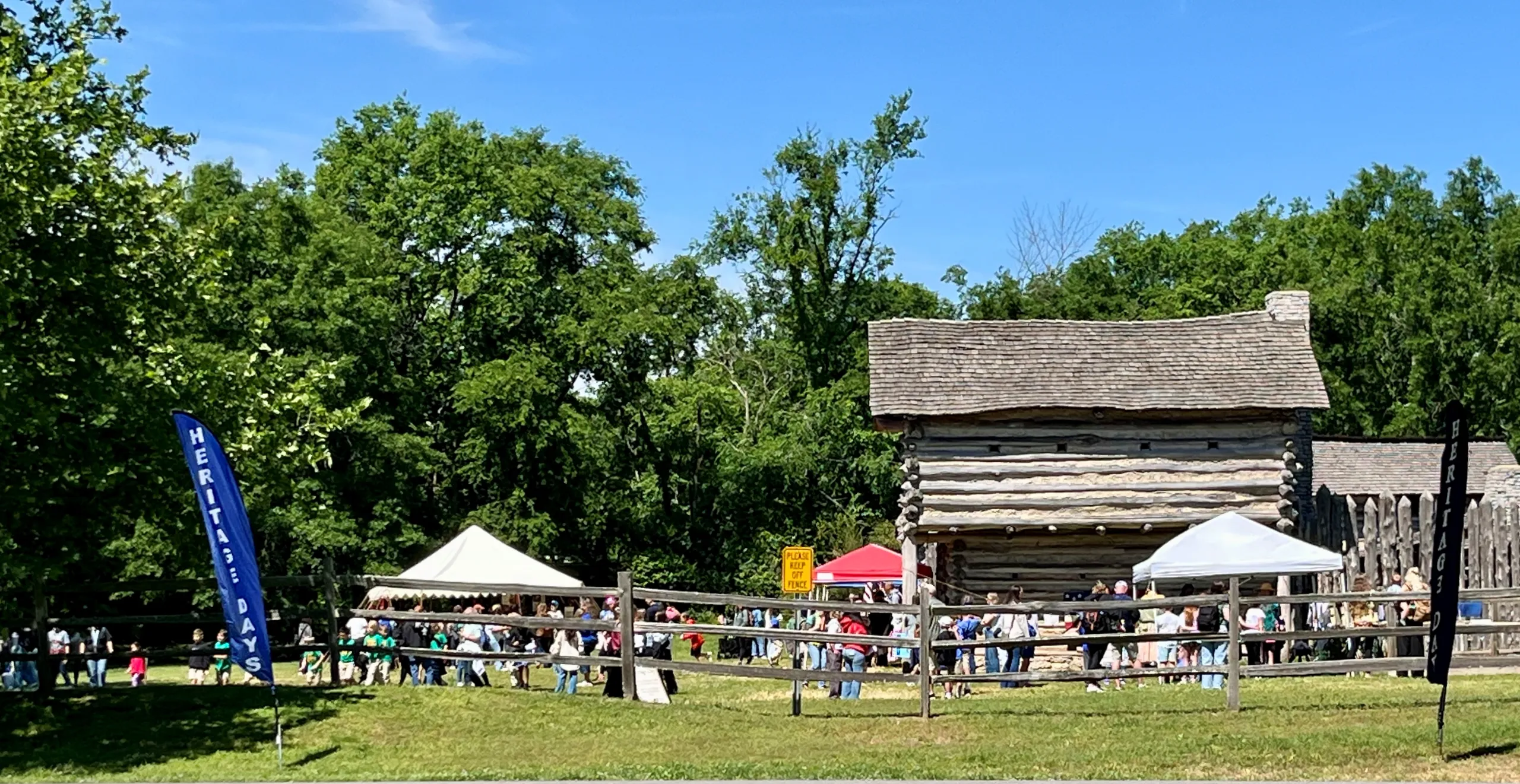
I’m always up for learning more about local history- Middle Tennessee being my “local”. So, when the folks at the City of Goodlettsville’s Tourism Department invited me to attend Mansker’s Station and Bowen House annual Heritage Days, I was delighted. Here’s a look at this enriching living history event and why you should make plans to attend next year.
If you’ve read my blog, you know this isn’t my first time visiting Mansker’s Station. I also visited during the Christmas season for the 2025 Yulefest celebration. You can read more about that special annual event in Yulefest at Historic Mansker’s Station.
What is Historic Mansker’s Station?
Mansker’s Station is a reproduction 18th century fort and the site of the historic Bowen House. Frontier forts like Mansker’s Station were built to provide settlers and travelers protection from Indian attacks and wild animals. These rustic communities offering shelter and basic services were the startups for many modern American cities.
Did you know Nashville, Tennessee began as an 18th century fort? You can find out more about Nashville’s beginnings in this article, Fort Nashborough on the Nashville and Davidson County website.

Here’s a little background on Mansker’s Fort and the Bowen House to give you some perspective before your visit.
Mansker’s Fort
A long hunter named Kasper Mansker came to Middle Tennessee and established Mansker’s Station in 1779. His fort was a waystation for travelers and for some, a permanent settlement. Many people that stayed at Mansker’s Station became significant characters in Tennessee history; none more significant than future U.S. President Andrew Jackson.

More information about the history of Mansker’s Station can be found at the Visit Goodlettsville’s website. I recommend reading the article “How Mansker’s Station Became Goodlettsville”.
The Historic Bowen House
The Bowen House was the home of Captain William Bowen, his wife, and nine children. Captain Bowen fought in the American Revolution. He and his family moved to Mansker’s Station in the 1780’s and became some of the first permanent settlers in Middle Tennessee. The Bowen House is the oldest standing brick home in the state.

Over the years, after being abandoned by the Bowen family, the home deteriorated into a dilapidated eyesore. Locals began reviving it in 1975. The home was restored to such exacting detail it earned a spot on the National Register of Historic Places.
Visit the visitor center’s museum to find out more about the history of Bowen House and its restoration. It’s good stuff!
Mansker’s Station Heritage Days Highlights
There were so many things I enjoyed about Heritage Days at Mansker’s Station, but here were my favorites. I’ll save the best for last.
The Cook, The Painter, and the Mantua Maker
The Cook
The kitchen outside the Bowen House was abuzz with activity when I arrived. Kids were crowded around the tables and listening intently (probably hoping for a sample) as Jennifer Kirk, staff member, demonstrated how cookies were baked in the 18th century.
Anyone who knows me personally knows I love to bake cookies. I earned the moniker “the cookie lady” years ago. But after watching Ms. Kirk’s demonstration, I promise you that baking cookies would have been a hard 18th century no for me.

Think about it. There were no grocery stores on the frontier. The cows had to be milked, butter churned, wheat ground, and fire kindled before you could even begin the batter. Can you imagine doing that today? I have a new appreciation for store-bought cutoffs!
If you think there’s a cookie worth the 18th century effort, I’d love your recipe, because I haven’t ever eaten a cookie that good.
The Painter
The painting demonstration was in my top three favorite Heritage Days exhibits. Years ago, I made my living as a decorative faux-finish artist, so I know a thing or two about mixing paints- in the 21st century. But in the 18th century, there was more to mixing colors than picking up a couple of bottles of paint and squirting them on a palette. In the old days, you had to create the paint- from scratch.

By “from scratch”, I mean artists had to find substances like colorful rocks and plant material to grind by hand to create individual colors. That process is extremely time consuming and an art form unto itself. Local painter, John Fottrell, does an excellent job explaining how he begins with rocks (or other substances) and ends with the striking paintings on display in the Bowen House. Beautiful!
There’s no stopping by a craft store to grab tubes of Alizarin Crimson and Phthalo Blue for Mr. Fottrell! (That’s a Bob Ross reference in case you didn’t know.) Fottrell makes all of his paints the old-fashioned way.
The Mantua Maker
I took some liberty in classifying demonstrator Jennifer Poole, part-time staff member, as a “mantua maker”. After some research, I discovered “mantua maker” was a 1700’s synonym for “dressmaker”, so my liberty is (hopefully) legit.
Also, “mantua maker” worked in place of “candlestick maker” in this section’s title, my play on the classic 18th century nursery rhyme, “Rub-a-dub-dub”. How convenient!

Ms. Poole is a talented local dressmaker who uses traditional sewing methods and original materials whenever possible. I was most impressed by her extensive collection of authentic 18th-19th century clothing. She owns the pieces on display and regularly adds to her collection with finds from local yard and estate sales.
Don’t miss the opportunity to visit with this bubbly and knowledgeable mantua maker inside the Bowen House.
The Blacksmith, The Medic, and the Laundress
The Blacksmith
If you’ve been to many living history events, you’ve probably seen a blacksmith demonstration. I’ve seen quite a few, but the one at Mansker’s Station Heritage Days has been the best yet.

I planned to breeze by this exhibit before leaving the fort, but blacksmith Pete Santoro, part-time staff member, held my attention for a good ten minutes. Watching him work the giant bellows to keep the fire stoked was mesmerizing.
There was a peacefulness about Mr. Santoro’s work I could see myself enjoying. (I’d probably end up with third degree burns, but I’d be at peace for a little while, anyway.)
The Medic
The 18th-19th century medical supply station is a Heritage Days can’t miss! What immediately drew my attention to this exhibit was the wooden ambulance.
Initially, I was disappointed to learn the ambulance was a reproduction, but when demonstrator Chris Leighton told me it was built by the Amish in Lawrence County, Tennessee, I was impressed! As a Lawrence County native, I’ve had the pleasure of visiting that Amish community many times.
If you know anything about Amish craftsmanship, you know those folks don’t do anything halfway. This ambulance isn’t just a reproduction; it’s a precise replica.

Mr. Leighton has an infectious passion for Revolutionary and Civil War era medical history. Make sure you look at the sink and surgical tools he has on display. It’s shocking how unclean surgeries were on the battlefield and amazing any patient lived.
Take your time at this exhibit and ask questions. Mr. Leighton has lots of fascinating, often gruesome answers.
The Laundress
For me, doing laundry in the 18th century would have been right up there with baking cookies. I hate doing laundry even with a washer and dryer that does all the work for me (besides the dreaded folding, of course). Demonstrator Rachel Gabriel did a wonderful job showing kids how laundry was done before the first washing machines became widely available.
I can’t imagine boiling water, scrubbing dirty clothes on a piece of wood, changing the water to rinse the clothes, and wringing them by hand before hanging them on the line to dry. No, thank you. I’d rather trash my clothes and give the mantua maker some business.

Because they had the chance to get their hands dirty (or clean depending on how you look at it), the laundry exhibit drew a crowd of kids. It was fun for me to stand back and watch.
Laundry would have been the best 18th century reason for me to have a passel of kids. I’d teach them responsibility at a very early age- first lesson being how to wash their own clothes- and mine.
Speaking of Kids…
Without a doubt, my favorite part of Mansker’s Station Heritage Days was the kids. A little chaotic? Sometimes. But it was the best kind of chaos!
My heart was so happy to see all of them running around from station to station excited about what they were seeing. Some kids paused just for a few moments before taking off for the next exhibit, but that was okay. Those moments are the seeds that grow lifelong learners.
When you get down to it, that’s what these living history events are all about. I’m sure the dedicated organizers of Mansker’s Station Heritage Days would agree.

Little do these kids know the impact their field trips may have on their futures. If your child’s schools aren’t already making plans to attend Mansker’s Station Heritage Days next year, encourage them to do so.
You Don’t Have to Wait for Heritage Days to Tour Mansker’s Station
Tours of Mansker’s Station are available Monday-Friday from 9:00 AM-3:00 PM. For more information about admission prices and arranging tours, visit the Mansker’s Station website.
And If You’d Like to Support Mansker’s Station
Historic sites including Mansker’s Station always appreciate volunteers. It takes a lot of people to pull off events like Heritage Days and to keep historic properties in pristine condition. If you can’t get involved with Mansker’s Station, get involved with something. Opportunities abound!
To find out how you can support Mansker’s Station, visit the City of Goodlettsville’s Volunteer Opportunities page.
We Are Living History
Our lifeways and actions will be studied by people far into the future. How do you want to be remembered? Does knowing we are living history change your perspective on what you do today? Reflect on that.
If you’re interested in touring other historic homes near Nashville, check out my post, Rippa Villa, Carnton, and Carter House – Middle TN Civil War Survivors. These local gems are worth the prices of their tours, but I’ll tell you how you can save a lot of money!
From the Library

After the Heritage Days event, I stopped by the visitor center’s gift shop and discovered The Journey and Sojourn of The William Bowen Family of Mansker’s Creek by Anne Cato Sowell. I highly recommend this booklet for anyone wanting to dive deeper into the history of Mansker’s Fort and the Bowen House. Very interesting!


Comments